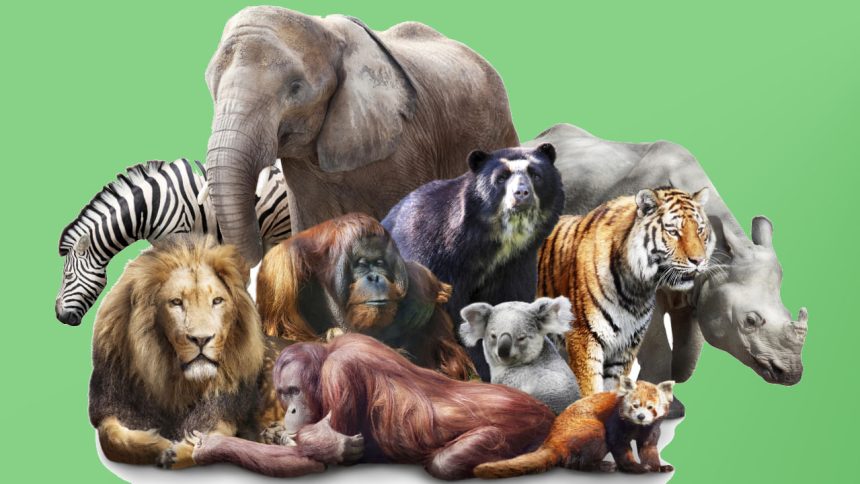
New Delhi: Mammals, classified under Mammalia, represent a highly evolved group within the subphylum Vertebrata. This diverse class is distinguished by several advanced physiological and anatomical traits, most notably the presence of mammary glands, which enable lactation and maternal nourishment of offspring.
Mammals exhibit a remarkable adaptability to a wide range of ecological niches, occupying environments from marine ecosystems and arid deserts to polar habitats and tropical rainforests. Their evolutionary success is evidenced by a vast array of morphological and behavioural adaptations that facilitate survival in varied biomes.
In the following article, we will delve into the intricate characteristics and taxonomic classifications of Mammalia, exploring their evolutionary history, reproductive strategies, and ecological significance.



Evolution of mammals
Origin
Synapsida is a group that includes mammals and their extinct relatives. It began around 323 to 300 million years ago during the Pennsylvanian subperiod when mammals separated from reptiles. Modern mammals trace their evolutionary ancestry to earlier mammaliaforms that emerged during the Early Jurassic period. In this framework, Mammalia is the primary clade from which contemporary mammals diversify.
Distinguishing features
Living mammals can be recognised by their sweat glands, including specialised ones that produce milk to feed their young. However, we can’t rely on these soft tissues for fossils, so we must look for other distinguishing features.
Jaw Joint: In mammals, the lower jaw (called the dentary) connects to a small bone in the skull (called the squamosal) to form the jaw joint. In most early fish-like ancestors, this joint was made up of different bones.
Middle Ear: In modern mammals, sound travels from the eardrum through three small bones called the malleus, incus, and stapes. Interestingly, the first two bones, the malleus and incus, originally came from parts of ancient jaw structures in their early ancestors.
Tooth Replacement: Different animals have unique ways of dealing with their teeth. Most mammals can only replace their teeth once when they lose them. However, some animals, like certain whales and rodents, can’t replace their teeth at all. On the other hand, animals like elephants, manatees, and kangaroos are special because they keep growing new teeth throughout their lives.
Tooth Enamel: The outer layer of teeth has a structure of tiny, rod-like shapes called prisms, extending from inside the tooth to its surface.
Skull Features: Mammals have two knobs at the base of their skulls that connect to the top vertebra of the neck, unlike many other four-legged animals, which generally have just one knob.
Most of these traits were not found in mammals’ early ancestors during the Triassic period. Additionally, nearly all early mammal-like creatures had a bone called the epipubic bone, except for modern placental mammals.
Sexual dimorphism
Sexual dimorphism is the term used to describe the noticeable differences between males and females of the same species. This can include size, colour, shape, and even behaviour variations. These differences often develop over time because they help with reproduction and survival in their natural environments.
On average, male mammals are larger than females, with males being at least 10 per cent bigger in over 45 per cent of species studied. This size difference, known as sexual dimorphism, is common, though some species, like rabbits and hares, may show no difference or larger females.
Larger mammals often show a greater size difference between males and females. This difference is usually related to male competition for mates.
In species that have more complex mating behaviours, males are generally larger. Interestingly, despite males competing more for mates, larger females often have fewer offspring, leading to smaller females being favoured by nature.
While these trends are widespread, there is considerable variation among different groups.
Biological systems
Most mammals have seven bones in their necks called cervical vertebrae. The manatee and the two-toed sloth possess six infraorbital foramen, whereas the three-toed sloth has nine. All mammals feature a distinctive neocortex integral for higher cognitive functions. Additionally, placental mammals exhibit the presence of a corpus callosum, a structure absent in monotremes and marsupials, which facilitates interhemispheric communication.
Digestive System: This system helps digest food. It includes the stomach, small intestine, large intestine, rectum, and anus.
Cardiovascular System: This system transports nutrients to cells and removes waste. It includes the heart, blood, and blood vessels.
Nervous System: Mammals can send, receive, and process nerve and sensory signals. The nervous system helps move muscles.
Respiratory System: This system exchanges gases, including organs like the nostrils and pharynx.
Arteries: These blood vessels carry oxygen-rich blood from the heart to the body.
Skeletal System: This system supports body weight and helps movement. It includes bones and cartilage.
Brain: The brain receives, processes, and converts environmental information. It also regulates important functions like breathing, sleep, and appetite.
Quick Facts about Mammals
– Mammals have hair or fur at some point in their lives.
– They are warm-blooded and can keep a steady body temperature.
– Most mammals give birth to live young, except for the platypus.
– All mammals produce milk to feed their young.
– Mammals have bigger and more complex brains than other animals.
– They have four limbs, which help them move on land, in water, or the air.
– Mammals can eat meat, plants, or both.
– Mammals appeared around the same time as dinosaurs and lived alongside them for 150 million years.