



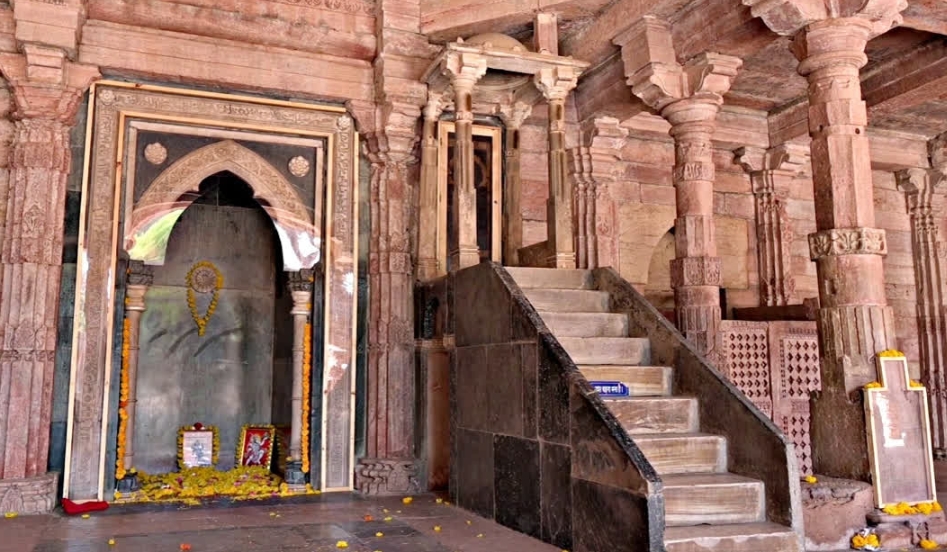
The Madhya Pradesh High Court’s decision declaring the Bhojshala complex in Dhar a temple dedicated to Goddess Saraswati is not merely another property dispute judgment. It is a ruling that touches three of India’s most sensitive fault lines at once faith, archaeology, and constitutional law.
In a detailed order delivered by the Indore Bench, Justices Vijay Kumar Shukla and Alok Awasthi held that the historical and archaeological record establishes Bhojshala as a centre of Sanskrit learning associated with Raja Bhoj and a temple dedicated to Goddess Vagdevi, another name for Saraswati. The court also struck down the Archaeological Survey of India’s 2003 arrangement that had allowed Hindus to perform puja on Tuesdays and Muslims to offer namaz on Fridays.
The verdict immediately triggered political reactions, legal preparations for appeals, and renewed debate over the future of disputed heritage sites in India.


A Case About More Than Worship Rights
For decades, Bhojshala represented a fragile administrative compromise.
The 11th-century ASI-protected monument has long been claimed by Hindus as a Saraswati temple and by Muslims as the Kamal Maula Mosque. The ASI’s 2003 arrangement attempted to manage competing claims through time-sharing access. Friday namaz was permitted for Muslims, while Hindus were allowed weekly worship.
The High Court has now fundamentally altered that arrangement.
The judges concluded that evidence from inscriptions, literary references, architectural features, and historical continuity of Hindu worship collectively established the site’s religious character as a Saraswati temple. The ruling also emphasized the state’s constitutional responsibility to preserve ancient monuments and their religious significance.
Importantly, the court did not order the demolition of any structure or endorse confrontation. Instead, it suggested that if the Muslim community seeks land elsewhere in Dhar district for mosque construction, the state government may consider such a request under the law.
That balancing language appears aimed at preventing the judgment from escalating into a law-and-order crisis.
Why the Court Relied Heavily on Archaeology
One of the most consequential aspects of the ruling is the court’s reliance on archaeological and historical evidence rather than purely theological claims.
Legal observers say this marks a broader judicial trend in disputes involving medieval religious structures. The High Court referred to historical literature connected to Raja Bhoj’s reign, architectural remains, inscriptions, and findings from scientific surveys conducted under court supervision.
This approach matters because it shifts such disputes from faith-based assertions toward evidence-based adjudication at least formally.
The judgment also reinforces the expanding role of the Archaeological Survey of India in religiously contested heritage cases. The ASI will continue to administer the site, while the Centre and the agency have been directed to frame its future management structure.
For heritage experts, the case raises a difficult question: can India preserve layered historical monuments without forcing them into exclusive religious identities?
Many medieval sites across the subcontinent contain overlapping architectural histories shaped by conquest, adaptation, reuse, and political transformation over centuries. Bhojshala now joins Ayodhya as a landmark case where courts have attempted to resolve those layered histories through legal finality.
The Places of Worship Act Debate Is Back
The ruling has also reignited national debate around the Places of Worship Act, 1991.
The law generally freezes the religious character of places of worship as they existed on August 15, 1947. However, lawyers representing the Hindu petitioners argued that the Act does not apply to monuments protected under the Ancient Monuments and Archaeological Sites and Remains Act.
Advocate Vishnu Shankar Jain, who represented the Hindu side, stated after the verdict that the immediate focus would be exercising worship rights under Article 25 of the Constitution and defending the judgment if challenged in the Supreme Court.
That legal argument could have implications far beyond Dhar.
Constitutional scholars note that if courts increasingly interpret ASI-protected monuments as exceptions to the Places of Worship Act, similar claims may emerge elsewhere. That possibility explains why reactions to the verdict quickly extended beyond Madhya Pradesh into discussions around Kashi and Mathura.
At the same time, Muslim organizations have signaled that they are likely to challenge the verdict before the Supreme Court.
This means the Bhojshala dispute may now evolve into a national constitutional battle rather than remain a regional heritage case.
The Political Messaging Around the Verdict
Madhya Pradesh Chief Minister Mohan Yadav welcomed the decision and appealed for social harmony, invoking the example of Ayodhya. He also said efforts would be made to bring back the idol of Goddess Vagdevi currently housed in London’s British Museum.
That statement is politically significant.
The return of religious artefacts from Western museums has become part of a broader cultural restitution movement led by India in recent years. The court itself noted that representations seeking the idol’s return may be considered by the Government of India.
If pursued diplomatically, the Bhojshala idol issue could evolve into another high-profile repatriation campaign similar to previous efforts involving temple sculptures and antiquities.
Why This Verdict Will Matter Nationally
The Bhojshala judgment is likely to influence three major areas of Indian public life in the coming years:
1. Future Religious Site Litigation
The verdict strengthens arguments that archaeological evidence can override long-standing administrative arrangements. That could encourage fresh litigation involving protected monuments elsewhere.
2. The Scope of the Places of Worship Act
The Supreme Court may eventually have to clarify whether ASI-protected monuments fall outside the protections of the 1991 law. That interpretation could reshape future disputes nationwide.
3. Heritage Preservation vs Religious Assertion
India increasingly faces the challenge of preserving multi-layered historical sites without reducing them to singular political narratives. Bhojshala demonstrates how difficult that balance has become.
For now, the High Court’s order has brought temporary legal clarity to a dispute that has lasted decades. But politically, culturally, and constitutionally, the debate surrounding Bhojshala is only entering a more consequential phase.