


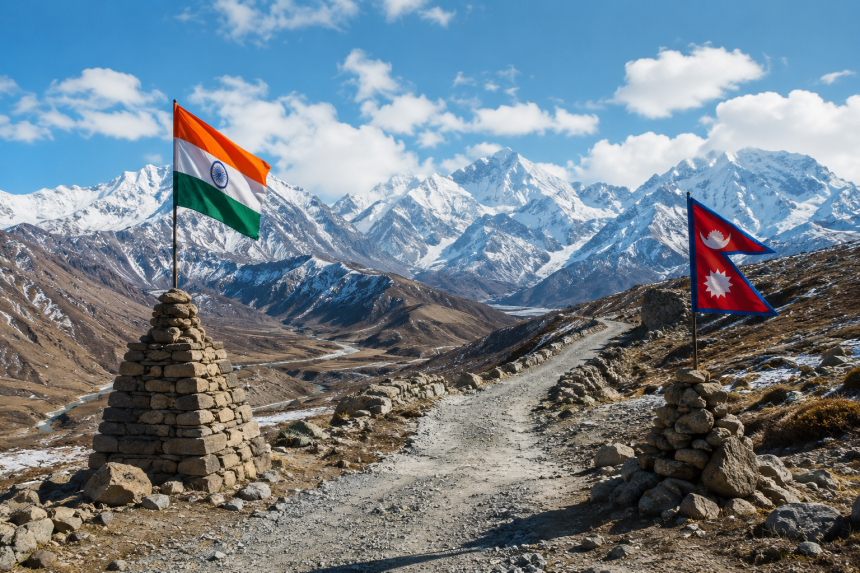
The long-standing border dispute between India and Nepal over the Lipulekh Pass has once again come into focus. The issue has gained renewed attention following India’s preparations for the 2026 Kailash Mansarovar Yatra through the Lipulekh route. While Nepal has reiterated its territorial claim over the area, India has maintained that the route has been used for decades for pilgrimage and border trade.
The latest round of diplomatic exchanges began after India announced arrangements for the Kailash Mansarovar Yatra scheduled between June and August 2026. Nepal responded by reiterating its claim over Lipulekh, Kalapani, and Limpiyadhura, arguing that these territories fall within its borders. India rejected the claim and stated that its position on the matter remains unchanged.
What Is Lipulekh Pass and Why Is It Important?
Lipulekh Pass is a high-altitude Himalayan mountain pass located near Pithoragarh district in the Indian state of Uttarakhand. The pass lies close to the tri-junction area of India, Nepal, and China’s Tibet Autonomous Region.
It serves as one of the key routes for the Kailash Mansarovar Yatra, a major pilgrimage for Hindus, Buddhists, and Jains. The area is also strategically important because it facilitates limited border trade between India and China and holds significance from a security perspective.
What Is Nepal’s Claim?
Nepal argues that under the 1816 Treaty of Sugauli, territories east of the Mahakali (Kali) River belong to Nepal. Based on its interpretation of the treaty, Kathmandu claims that Lipulekh, Kalapani, and Limpiyadhura are part of Nepalese territory.
In 2020, Nepal officially updated its political map to include these areas, intensifying the dispute and leading to repeated diplomatic exchanges between the two countries.
What Is India’s Position?
India maintains that Lipulekh has been under its administration for decades and has long been used for the Kailash Mansarovar Yatra as well as border trade.
India’s Ministry of External Affairs has repeatedly stated that its position on Lipulekh is “clear and consistent.” New Delhi has also argued that Nepal’s claims are not supported by historical evidence and that any border-related issues should be resolved through established diplomatic mechanisms and bilateral dialogue.
Why Has the Issue Re-Emerged in 2026?
The controversy has resurfaced because the Lipulekh route is one of the main pathways used for the Kailash Mansarovar Yatra. As India resumed preparations for the pilgrimage season in 2026, Nepal once again raised objections, claiming that activities in the area involve disputed territory.
The renewed attention has brought the decades-old border dispute back into the spotlight of South Asian diplomacy.
Why Did the Dispute Intensify After 2020?
Although the disagreement over Lipulekh and Kalapani is not new, it became significantly more prominent in 2020. The dispute escalated after India inaugurated a road link to Lipulekh, prompting Nepal to release a new political map showing Lipulekh, Kalapani, and Limpiyadhura as part of its territory.
Since then, both countries have continued to defend their respective claims while emphasizing the importance of dialogue.
How Does It Affect India-Nepal Relations?
Despite the border dispute, India and Nepal share deep cultural, economic, and people-to-people ties. The two countries maintain an open border, allowing extensive movement of people and trade.
As a result, both governments have generally sought to prevent the disagreement from escalating into a broader confrontation. Recent statements from both sides have continued to emphasize diplomatic engagement and peaceful resolution.
Why Does the Lipulekh Issue Matter?
The Lipulekh dispute is not merely a disagreement over a boundary line. It involves strategic security considerations, India-Nepal relations, China’s regional role, border trade, and the Kailash Mansarovar pilgrimage.
For this reason, any development related to the area attracts attention across South Asia and has broader geopolitical implications.
FAQs
Where is Lipulekh Pass located?
Lipulekh Pass is located in the Himalayan region near Pithoragarh district in Uttarakhand, India, close to the border with China’s Tibet Autonomous Region.
Why does Nepal claim Lipulekh?
Nepal bases its claim on its interpretation of the 1816 Treaty of Sugauli, arguing that Lipulekh, Kalapani, and Limpiyadhura fall within Nepalese territory.
What is India’s stance on the issue?
India maintains that the area has long been under its administration and that Nepal’s claims are not supported by historical evidence.
How is the Kailash Mansarovar Yatra connected to the dispute?
One of the main routes for the Kailash Mansarovar Yatra passes through Lipulekh Pass, making the area a recurring point of contention between the two countries.
Is this a new dispute?
No. The dispute over Lipulekh, Kalapani, and Limpiyadhura has existed for decades, although it gained greater prominence after 2020 and has resurfaced periodically since then.
