



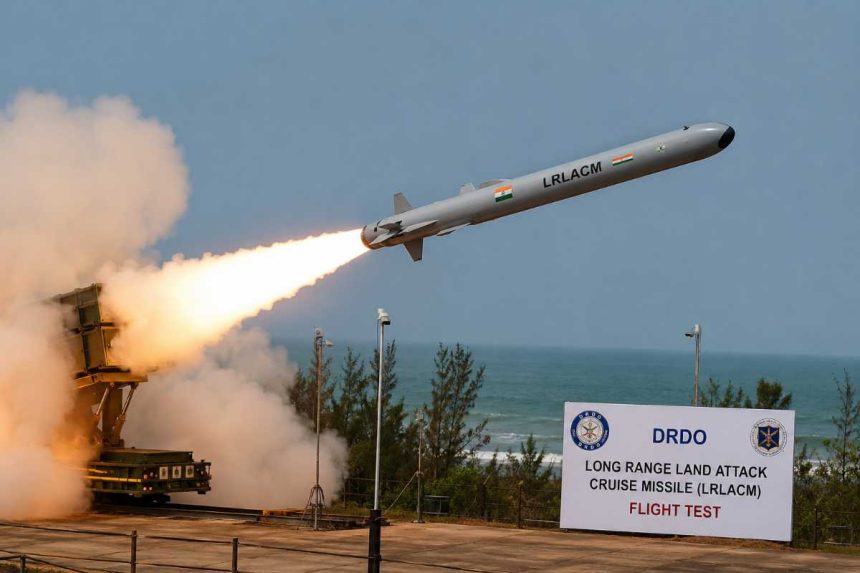
India’s defence research ecosystem achieved another significant milestone as the Defence Research and Development Organisation (DRDO) successfully conducted a flight test of the indigenous Long-Range Land Attack Cruise Missile (LRLACM). The test was carried out from Dr. APJ Abdul Kalam Island off the coast of Odisha, marking a major step forward in strengthening the country’s long-range precision strike capabilities.
Successful Flight Test Conducted from Odisha Coast
According to official information, the missile was launched from Dr. APJ Abdul Kalam Island and successfully met all mission objectives during the flight. The test was monitored through a network of tracking and telemetry systems deployed at the Integrated Test Range (ITR) in Chandipur, Odisha. Data collected during the mission confirmed the successful performance of the missile and its onboard systems.
Indigenous Missile Developed Through National Collaboration
The LRLACM is a fully indigenous cruise missile developed by DRDO with contributions from multiple laboratories and Indian industry partners. The Aeronautical Development Establishment (ADE), Bengaluru, serves as the nodal laboratory for the programme.



The missile represents India’s growing capability to design and develop advanced precision-guided weapons domestically, reducing dependence on foreign technologies while strengthening the country’s defence manufacturing ecosystem.
Senior Defence Officials Witnessed the Launch
The flight test was witnessed by senior DRDO officials along with representatives from the Indian Navy and the Indian Air Force. Defence Minister Rajnath Singh congratulated the DRDO team and industry partners for the successful achievement.
Defence Secretary and DRDO Chairman Rajesh Kumar Singh monitored the launch activities and praised the scientists, engineers, and technical teams involved in the programme.
Part of a Series of Recent Defence Technology Demonstrations
The successful LRLACM test comes shortly after a series of major defence trials conducted by DRDO on June 10 and 11. These tests were aimed at demonstrating India’s multi-layered defence capabilities against long-range ballistic missile threats and medium-range anti-ship challenges.
The trials highlighted the country’s efforts to strengthen its missile defence architecture amid evolving regional and global security challenges.
Ballistic Missile Defence System Demonstrates Advanced Capabilities
During the recent tests, India successfully demonstrated the effectiveness of its multi-layered Ballistic Missile Defence (BMD) system. Interceptor missiles accurately engaged and destroyed their designated targets, validating advanced technologies developed to counter emerging missile threats.
Defence experts view these developments as important steps toward enhancing India’s ability to defend critical assets and strategic infrastructure.
Progress Toward Countering Advanced Missile Threats
Officials stated that the successful demonstrations place India among a select group of nations possessing advanced ballistic missile defence capabilities designed to address high-end missile threats, including those associated with intercontinental-range systems.
In addition, the first flight test of the Naval Anti-Ship Missile – Medium Range (NASM-MR) was also reported as successful, further expanding India’s indigenous missile portfolio.
Strengthening India’s Defence Self-Reliance
The successful test of the Long-Range Land Attack Cruise Missile underscores India’s continued progress in defence self-reliance and indigenous technology development. With growing participation from domestic industries and research institutions, the country’s defence sector is steadily advancing its capability to develop sophisticated weapon systems for future operational requirements.
As India continues to invest in advanced missile technologies, programmes such as the LRLACM are expected to play a key role in enhancing strategic deterrence and strengthening national security.