



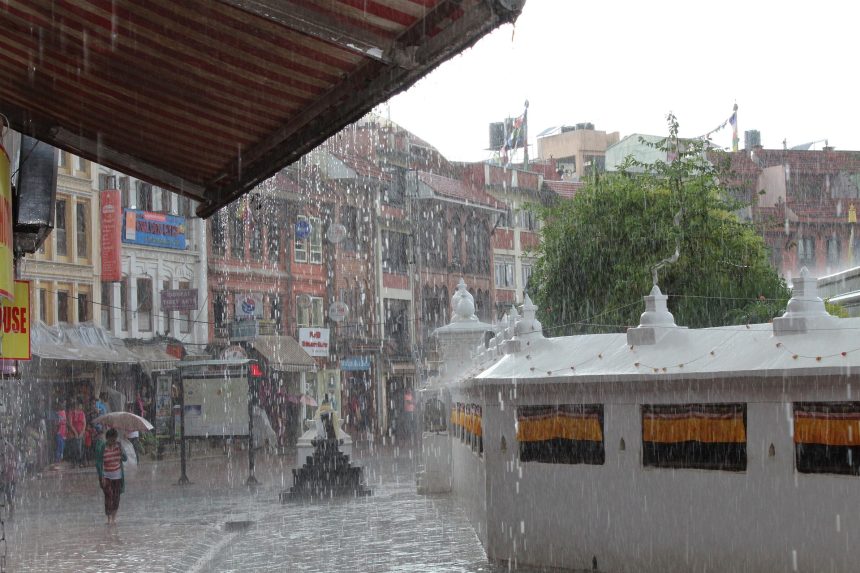
New Delhi. The Southwest Monsoon is advancing rapidly, and weather conditions across many parts of the country are set to undergo a significant change. The India Meteorological Department (IMD) has issued a warning for heavy rainfall, thunderstorms, gusty winds, and—in some areas—thunder squalls with speeds of 50 to 60 kmph for June 7. The monsoon has already reached Maharashtra, Goa, Karnataka, Andhra Pradesh, Tamil Nadu, and parts of the Northeast, with further advancement expected over the next two to three days.
Monsoon picks up pace: Which areas have been reached?
According to the latest IMD update, the Southwest Monsoon has arrived over additional parts of the Arabian Sea, the entirety of Goa, several regions of Karnataka, parts of Maharashtra and Andhra Pradesh, most of Tamil Nadu, and some states in Northeast India. The weather department states that conditions remain favorable for the monsoon to advance further into the remaining areas of Maharashtra, Telangana, Andhra Pradesh, Karnataka, Tamil Nadu, and the Northeastern states.
Warning of heavy to very heavy rainfall in these states
Heavy to very heavy rainfall is likely at several places in Coastal Karnataka, Kerala, and Mahe on June 7. Additionally, heavy rainfall is predicted for the Andaman and Nicobar Islands, Arunachal Pradesh, Assam, Meghalaya, Nagaland, Manipur, Mizoram, Tripura, Konkan-Goa, Madhya Maharashtra, Rayalaseema, Tamil Nadu, Puducherry, Karaikal, Lakshadweep, and Sub-Himalayan West Bengal-Sikkim.
Risk of thunder squalls and strong winds from Rajasthan to Chhattisgarh
The weather department has warned of thunder squalls with speeds of 50 to 60 kmph in parts of Western Rajasthan and Chhattisgarh. Strong winds accompanied by heavy rain are also expected in the Andaman and Nicobar Islands. Such conditions carry the risk of uprooted trees, disruptions to power supply, and impacts on road traffic. Storms and Strong Winds Across Several States, Including Bihar, UP, and Madhya Pradesh
Strong winds blowing at speeds of 40 to 50 kmph are expected in parts of Bihar, Jharkhand, Madhya Pradesh, Odisha, Telangana, West Bengal, Sikkim, Maharashtra, and Karnataka. Thunderstorms and lightning strikes are also anticipated. A cyclonic circulation over Uttar Pradesh may lead to weather changes in the eastern and north-eastern regions.
Heatwave Conditions Persist in Some Areas Despite Rain
While monsoon and pre-monsoon activities are intensifying across most of the country, heatwave conditions are expected to continue in parts of Odisha and coastal Andhra Pradesh. The Meteorological Department has forecast heatwave conditions in these areas and “warm night” conditions in parts of Odisha, meaning nighttime temperatures could remain above normal.
Special Advisory for Fishermen
Due to adverse weather conditions at sea, the IMD has advised fishermen against venturing out. Strong winds reaching speeds of 40 to 55 kmph are predicted for the Southwest and West-Central Arabian Sea, the coasts of South Maharashtra-Goa, Kerala, Karnataka, Lakshadweep, the Gulf of Mannar, the Comorin area, South Tamil Nadu, and parts of the Bay of Bengal. Wind gusts could reach 60 to 65 kmph in some locations.
Why is this Monsoon Crucial?
The agricultural sector, water storage levels, and the sowing of Kharif crops depend directly on the progress of the monsoon this year. India receives a significant portion of its annual rainfall from the monsoon season, which runs from June to September. Consequently, the active monsoon in its initial phase is seen as welcome news for farmers. However, weather experts are closely monitoring the evolving situation, as there is a risk of localized waterlogging and traffic disruptions due to heavy rainfall in several areas.
Important Advice for the Public
Do not stay in open fields during thunderstorms.
Do not seek shelter under trees if there is a risk of lightning. Avoid unnecessary travel in areas experiencing heavy rainfall.
Fishermen should not venture out to sea until weather conditions normalize.
Keep an eye on the latest updates from the local administration and the Meteorological Department.